Well we are again in the low part of the cycle for the photovoltaic output and the core temperature.
This last month was a typical June with only 115kWhr's being produced for the month. The highest run for a day was only 7.53kWhr's on the first day of the month and nine days gave us less than 2kWhr's.
The graph below shows the comparison in monthly photovoltaic power runs for the last three years up to the end of June. Note the system started in February 2012.
The temperature in the core reserve from the DSHH system is now down to 22 degrees and this is the baseline
setting for the internally heating system. This means we won't use any more heat from the core and hence we have to start back filling
with electric heating, but already we are noticing through the power
accounts that we are using significantly less to top up compared with
the previous years. The winter sun still increases the core and keeps the floor slab within a comfortable range of 19 - 22 degrees.
Follow the home as it is built with sustainable and environmental features. Look at the links and see the individual features included in the build.
Wednesday, 2 July 2014
Thursday, 5 June 2014
Results for April and May
Its been two months since the last post, and during most of this time we have been away.
The house has continued to perform as expected and we are now just days away from the shortest day in mid winter.
The core temperature has slowly moved down to sit at 23 degrees, however the house is still keeping a comfortable 20 degrees during the day and night without any supplementary heating as yet. That may change as we get deeper into winter.
Compared with the first two years we are significantly better off and as the core continues to store more heat each year within the next 2 years we should have heating all year round.
April and May were very poor weather months with 13 days and 14 days with less than 4kwhr's being generated. Very wet and miserable. The highest day in April was 11.3kwhr's on the 1st and in May just 8.26kwhr's with the lowest just 0.554kwhr's.
April provided 167.2 kwhr's and May 150.2 kwhr's.
The house has continued to perform as expected and we are now just days away from the shortest day in mid winter.
The core temperature has slowly moved down to sit at 23 degrees, however the house is still keeping a comfortable 20 degrees during the day and night without any supplementary heating as yet. That may change as we get deeper into winter.
Compared with the first two years we are significantly better off and as the core continues to store more heat each year within the next 2 years we should have heating all year round.
April and May were very poor weather months with 13 days and 14 days with less than 4kwhr's being generated. Very wet and miserable. The highest day in April was 11.3kwhr's on the 1st and in May just 8.26kwhr's with the lowest just 0.554kwhr's.
April provided 167.2 kwhr's and May 150.2 kwhr's.
Sunday, 13 April 2014
March Results
Well what can you say, we had a mixture of drought and little sun followed by lots of drizzle and wind.
All in all not a very good summer with 1848 kwHr's during the last six months compared with the same period last year when 1982 kwHr's were generated, nearly 8% less.
Needless to say the core temperature has plateaued at 29 degrees as we head into autumn and winter. The total heat mass however should be significantly improved on last year.
The DSHH system has now been turned back onto normal from the summer mode and heat from the core will now supplement daily heat gain in keeping the house at our 21 degree temperature.
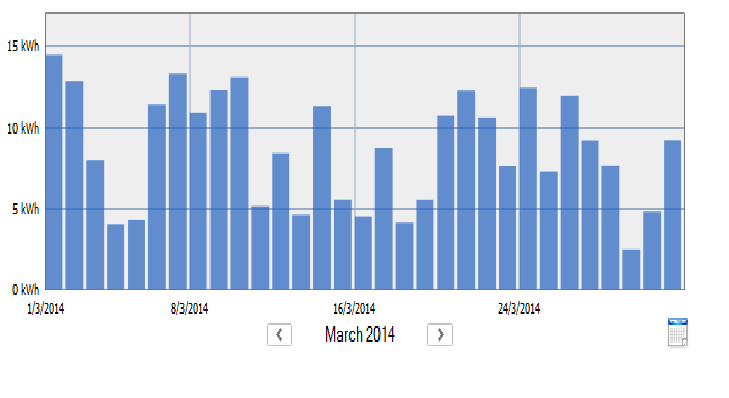
As you can see the month was very patchy with no consistent period of sun. The best day was the 1st March with 14.47kwHr's being generated but there were 8 days with less than 5kwHr's. Overall a poor month.
The trend for the year is similar with previous ones as we head into autumn and winter, however the house is now in a much better steady state with the new front door adding an extra element of thermal seal to the house. It will be interesting to see how the core stands up this year compared with the first two years.
More on this in the coming months.
All in all not a very good summer with 1848 kwHr's during the last six months compared with the same period last year when 1982 kwHr's were generated, nearly 8% less.
Needless to say the core temperature has plateaued at 29 degrees as we head into autumn and winter. The total heat mass however should be significantly improved on last year.
The DSHH system has now been turned back onto normal from the summer mode and heat from the core will now supplement daily heat gain in keeping the house at our 21 degree temperature.
As you can see the month was very patchy with no consistent period of sun. The best day was the 1st March with 14.47kwHr's being generated but there were 8 days with less than 5kwHr's. Overall a poor month.
The trend for the year is similar with previous ones as we head into autumn and winter, however the house is now in a much better steady state with the new front door adding an extra element of thermal seal to the house. It will be interesting to see how the core stands up this year compared with the first two years.
More on this in the coming months.
Sunday, 2 March 2014
February Results 2014
The results continue to indicate that this summer has provided less sun hours than the previous two seasons and February is no different with 310.76kWhr's during the month down from 339 last year.
The best day during the month was on the 3rd with just over 15kWhr's generated.
During the month the core heat storage in the DSHH system has slowly moved up to 30 degrees.
We have tested the back-up power system for the DSHH system during the month and the back-up PV panel which runs the pumps during a power outage worked as expected with no discernable issues over a five hour period. This gives assurance that in a power outage situation the water in the solar system can continue to be pumped and over heating is not an issue.
The annual report for the 2013 year is up on the site under Annual Reports
The best day during the month was on the 3rd with just over 15kWhr's generated.
During the month the core heat storage in the DSHH system has slowly moved up to 30 degrees.
We have tested the back-up power system for the DSHH system during the month and the back-up PV panel which runs the pumps during a power outage worked as expected with no discernable issues over a five hour period. This gives assurance that in a power outage situation the water in the solar system can continue to be pumped and over heating is not an issue.
The annual report for the 2013 year is up on the site under Annual Reports
Sunday, 2 February 2014
January 2014 Results
Quite an ordinary start to the year with plenty of rain and wet days during the month along with plenty of wind.
The best day generated 16.45kWh on the 6th January with the month producing 359.64kWhr's down from last year by 10kWhrs.
The chart shows the result for January compared with last year and the steady trend of power generated.
The core temperature has slowly risen, but not as fast as expected due to the poor weather. February and March should both be much better months.
The temperature is now up to 29 degrees steady, but even today it is up to 31 during the day as it spreads the heat across the whole 248 cubic meters of storage. The core should be up to 33 degrees by the end of March and this will have a great effect on our heat available during the winter. Still one full year away from getting the core up to optimum temperature.
The Annual Report for the 2013 year will be available by the middle of the month.
The best day generated 16.45kWh on the 6th January with the month producing 359.64kWhr's down from last year by 10kWhrs.
The chart shows the result for January compared with last year and the steady trend of power generated.
The core temperature has slowly risen, but not as fast as expected due to the poor weather. February and March should both be much better months.
The temperature is now up to 29 degrees steady, but even today it is up to 31 during the day as it spreads the heat across the whole 248 cubic meters of storage. The core should be up to 33 degrees by the end of March and this will have a great effect on our heat available during the winter. Still one full year away from getting the core up to optimum temperature.
Sunday, 5 January 2014
December Results - Nearly Two Years
Well here we are after a very wet and windy Wellington in December.
Even with the poor month we have still achieved a better PV run for the month with 335.13 kwhr's and 2.923 Mwhr's for the calendar year.
As you can see it was very patchy month with a lot of days with very limited sun and hence little consistency.
However the run for the month was still better than last year which was also a very poor month.
Even with the poor month we have still achieved a better PV run for the month with 335.13 kwhr's and 2.923 Mwhr's for the calendar year.
As you can see it was very patchy month with a lot of days with very limited sun and hence little consistency.
However the run for the month was still better than last year which was also a very poor month.
The next blog will give us two years of results and will lead into the annual report. So watch this space.
The core temperature for the house has now reached 28 degrees and I'm expecting to see this get to 35 by the end of summer.
Sunday, 8 December 2013
November 2013
November has proven to be a damp month with less sunshine than last year. We struggled to get an increase in power generated during the month with the best day being right at the start with just over 15 kwhr's on the 2nd.
The amount of PV power generated at 304 kwhrs for the month is less than the 342 kwhrs last year, however we are still above the total for the year.
Subscribe to:
Posts (Atom)